
If your general contractor needs a coordination model and your office does not have spare modeling capacity, the first question is not simply which BIM company is cheapest. It is which provider can define and deliver the part of the project your trade actually owns. A polished model can still leave you without issue tracking, revision support, or an agreed handoff for the field.
Use the same starting package when comparing providers. Otherwise, one quote may cover drawing conversion while another includes recurring coordination meetings and model changes. Those are different assignments, even if both are called BIM services.
Start with trade fit, not a generic software list
Ask for a relevant example and a walkthrough of the deliverable. The question is how the provider handles your systems and interfaces, not whether its website lists Revit and Navisworks. These are useful questions for a shortlist:
- HVAC contractors: Does the scope distinguish ductwork, piping, equipment, insulation allowances, and agreed maintenance or replacement access zones?
- Electrical BIM coordination: Which raceways, trays, equipment, supports, and access zones are included for the electrical contractor? Who reviews routing changes and coordination with other systems?
- Plumbing contractors: Are slopes, elevations, penetrations, and access requirements part of the agreed modeling inputs and review process?
- Fire-protection contractors: Who retains responsibility for system design, calculations, approvals, and installation requirements? A spatial model is not a substitute for that work.
These questions are a selection framework, not a statement that every provider handles every trade. Confirm the specific capability and scope before sharing a project or accepting a quote.
For electrical BIM coordination, ask the shortlisted provider to separate spatial modeling and issue tracking from electrical design, calculations, code-compliance review, and fabrication-release responsibilities. Request evidence of the specific electrical scope it proposes to support. Including a trade in a comparison checklist does not establish that a provider is qualified to deliver it.
Compare the written scope side by side
| Decision | Ask the provider to specify |
|---|---|
| Starting information | Drawing revisions, specifications, reference models, coordinates, and unresolved inputs. |
| Model requirements | Included systems and areas, element-level development requirements, software version, and file standards. |
| Coordination ownership | Who combines models, runs checks, assigns issues, attends meetings, and verifies closure. |
| Changes | Included review cycles and the process for changed design information, late equipment selections, or added areas. |
| Handoff | Native files, agreed exports, issue records, drawing outputs, and the contractor's acceptance review. |
Do not treat a level-of-development label as a complete specification. Write down which elements it applies to, the information they rely on, and the uses the team expects. Also distinguish a coordination model from fabrication-ready detailing. Autodesk's fabrication configuration guidance describes the content and product-data setup involved in Revit fabrication work; that work should not be assumed merely because the model is in Revit.
Ask to see an issue move from discovery to closure
A model screenshot shows geometry. It does not show how a coordination decision gets made. Ask the provider to demonstrate an issue with a location, the affected model versions, a responsible party, a due date, the proposed response, and a check of the updated condition. The contractor should be able to tell which items remain unresolved.
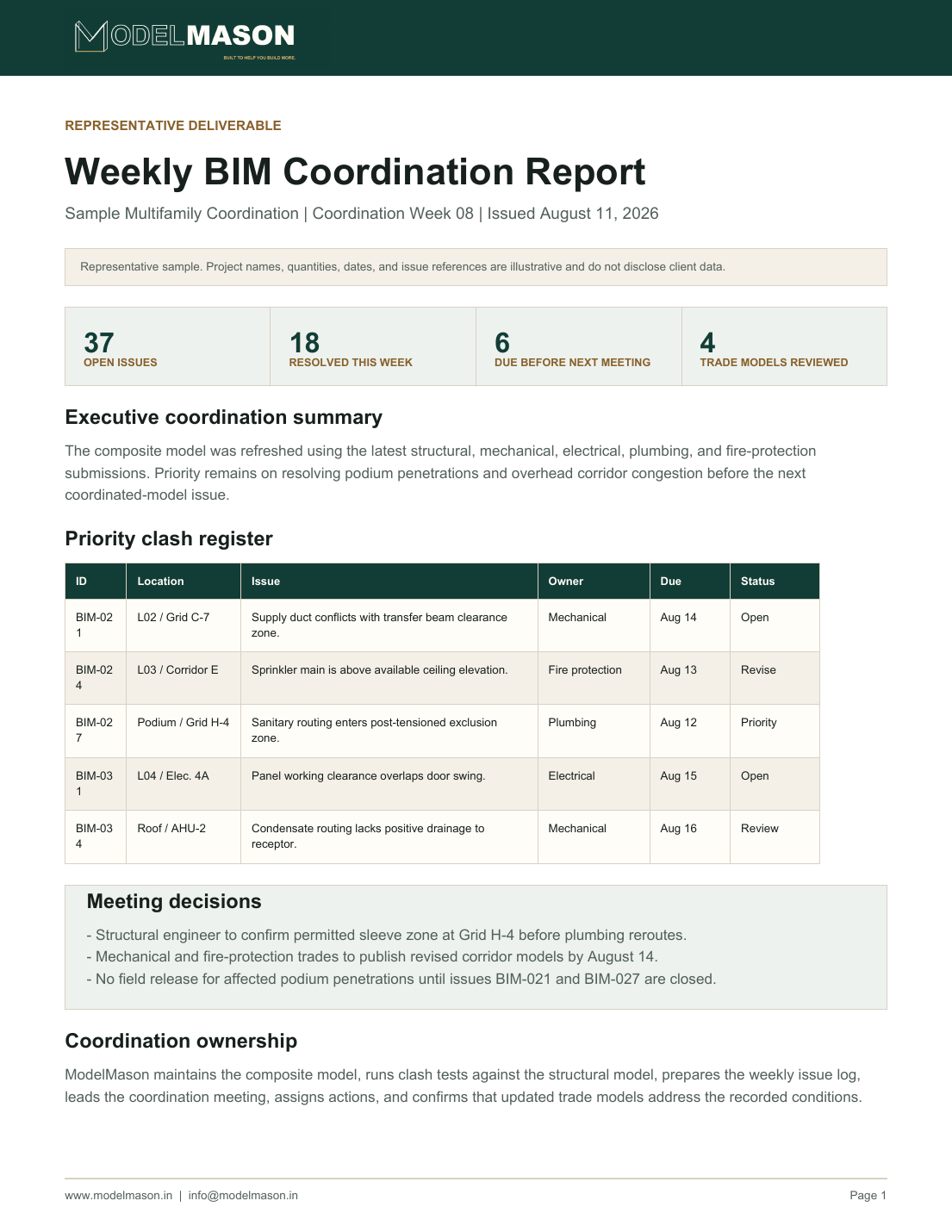
Read what belongs in a BIM coordination report for the review fields. ModelMason's 416-unit coordination case study describes its reported project experience; ask how the proposed responsibility compares with your assignment.
Send a package that makes the quote comparable
Provide the current drawings and specifications, trade boundaries, available models, software requirements, coordination milestones, expected outputs, and the person who will review the work. Identify information that is preliminary. The BIM project-input checklist can help organize that handoff.
Ask each shortlisted provider to list assumptions, exclusions, schedule dependencies, and change handling in writing. If a bid is lower, find out what work has moved back to your team. A useful price comparison is a comparison of complete responsibilities, not just model production hours.
For ModelMason, begin with 3D BIM modeling and coordination services and request a review of your trade scope. Modeling support does not transfer engineering, code-compliance, fabrication-release, or field-verification approvals away from the responsible project professionals.