
A subcontractor looking for estimating help may have a bid due, a backlog of drawing sets, and very little time to compare proposals. The phrase "construction estimating service" can describe several different deliverables. Before comparing fees, identify which part of the bid process you need someone to own.
A quantity takeoff measures the agreed scope. A priced estimate applies an agreed cost basis to that scope. Bid support may also include reviewing addenda, collecting quotations, organizing exclusions, and preparing a handoff. None of those labels should silently transfer final bid approval away from the contractor.
Separate quantities from pricing responsibility
If you already have labor rates, vendor relationships, and a pricing workbook, measured quantities may be the missing input. In that case, specify units, breakdowns, drawing references, and the file format your estimator needs. If you want pricing support too, identify who supplies material quotations, labor assumptions, productivity information, waste factors, and markups.
Do not assume a provider's generic cost allowance is a current supplier quote or a reliable measure of your crew's production. Record the source and date of pricing information, who verifies it, and what remains provisional. Your authorized estimator should review those inputs before a bid is released.
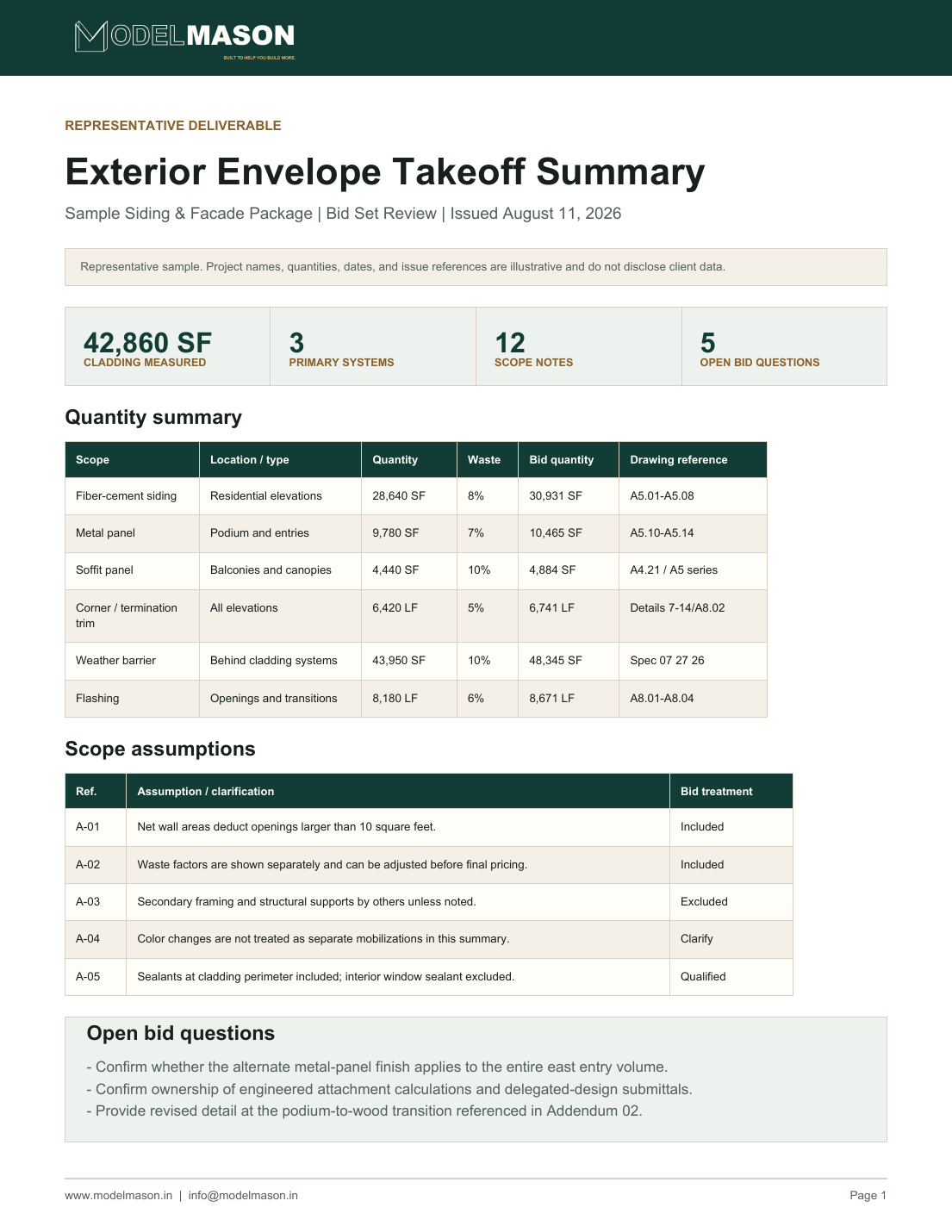
Ask for a handoff another estimator can review
A total on its own is hard to check. A usable deliverable lets your team follow a quantity or allowance back to the working documents and understand the assumptions behind it. Include the following in the proposal:
- Document register: the drawings, specifications, schedules, and addenda used, with their issue dates.
- Trade breakdown: quantities organized by the materials, assemblies, locations, or phases you actually price.
- Scope record: inclusions, exclusions, alternates, allowances, and unresolved questions.
- Review trail: drawing references, marked-up locations where agreed, and a record of important interpretations.
- Editable output: the agreed workbook or takeoff format, rather than only an image or a final total.
Trade detail matters. A flooring contractor may need a breakdown by finish and room. A siding contractor may need elevation and assembly distinctions. A signage contractor may need sign types, locations, and message or schedule references. The useful structure is the one that supports your purchasing and pricing decisions.
When comparing drywall estimating services, specify the wall types, heights, board layers, ceiling scope, and required quantity breakdown. Ask how the estimator will record assembly assumptions, openings, and addendum changes. Your team should be able to trace the quantities to the working documents before applying its rates and approving the bid.
Make addenda and revisions part of the agreement
Identify the document cutoff for the initial takeoff, the bid due date, and the review date your team needs before submission. Ask how late addenda are received, compared, and incorporated. A revision should show what changed, which quantities or assumptions were affected, and what still needs a decision.
Compare the proposals using the same questions:
- Does the fee cover the complete trade scope or a defined set of items?
- Which pricing inputs are included, and which must our team supply?
- How many review cycles or document updates are included?
- What happens when information is missing or contradictory?
- Who checks the output, and how much review time is allowed before the bid deadline?
A quick turnaround is not useful if it leaves no time to resolve a major scope question. Agree a checkpoint for open items before the final handoff, especially when the bid set is incomplete.
Choose a starting assignment you can evaluate
Start with a clearly defined drawing package and an agreed output. Review quantity traceability, scope questions, file usability, and how well the provider follows your conventions. That review gives you better evidence for an ongoing assignment than a promise of a certain number of bids per week.
ModelMason's estimating and takeoff services can be scoped around a contractor's quantities, templates, and review process. Explore trade-specific workflows for siding and facade, flooring, drywall, and signage. Your team retains control of final pricing and bid approval.
To compare a real assignment, share the current bid set, trade scope, preferred format, and due date. State whether you need takeoff only, pricing support, or recurring bid administration so the proposal answers the right question.